
arts 114:INTRODUCTION TO 3D DESIGN
PROJECT 1:
WIRE SCULPTURE


While creating this wire sculpture of a ballerina, I wanted to capture a graceful yet complex movement with how I shaped the wire. There is so much that is required of a dancer's body, while still looking beautiful and graceful. As I began the assignment, I started by sketching the dancer with the quick line gesture drawing method by capturing the overall shape and structure of the body. Then I went in and added "details" with both simple contour lines and cross contour lines.
PROJECT 2:
ROBOT SCULPTURE

I wanted to incorporate a variety of different geometric shapes, lines, and curves that worked in harmony to create the dimensions and details of the robot. I think I did well capturing the overall look of the sketch and did not stick with the same monotonous shapes.This added a little aspect of interest and texture.

The head of the robot is a "mailbox" shape, which incorporates curvature. I used quilling techniques to add the details of the nuts and bolts. I even added more texture by layering pieces of folded paper at the bottom of the body forming a fringe appearance.
PROJECT 3:
RELIEF CLAY TILE

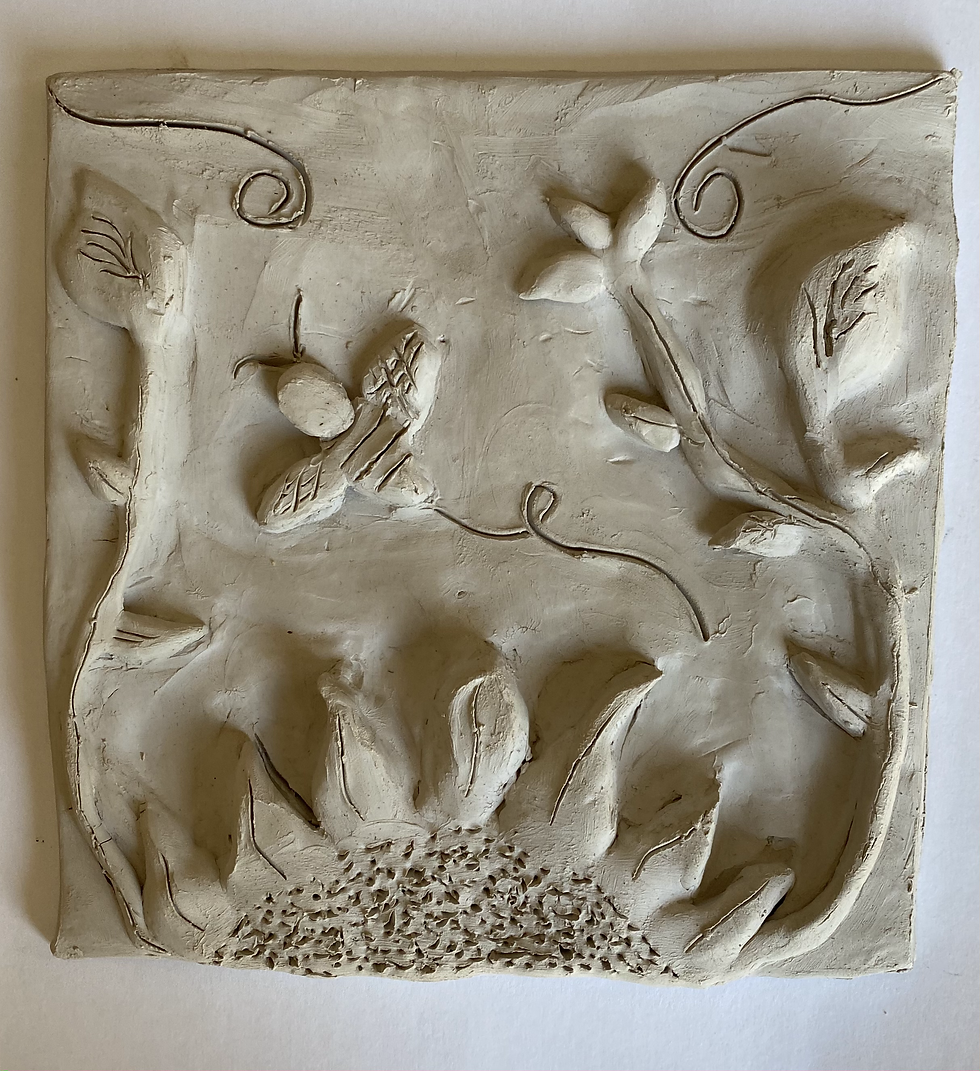
My clay tile was achieved through multiple techniques and methods taught from the course. I began by tracing out my design onto a block of clay. I then used the additive technique by adding clay to the traced out areas to start to form the relief aspect of the tile. Finally, I used the subtraction method my scraping and carving the clay to make the objects appear as if they were coming out from the block of clay.
PROJECT 4:
CLAY ELEPHANT

The goal of this project was to recreate an artist's sculpture using the technique of faceted planes. I chose an elephant sculpture originally done by artist, Nick Mackman. I wanted to recreate the chosen artist's sculpture in a way that was inspired by the original, yet still unique in itself. The original sculpture was very detailed. Applying the goal for this assignment, I tried to break the sculpture down into simple shapes that would eventually help me while drawing the sculpture.

Maintaining the correct proportions was found to be helpful in creating a form that was unified through the invisible lines through the body of the elephant. Proper proportions were achieved when line, shape, form, and value were focused on. When sculpting the elephant, I found it to be like a puzzle. I would have one proportion correct, then I would have to find the next correct proportion.

When I focused on the line, shape, form, and value, each of the once separate parts began to mesh into one cohesive piece of clay as I continued tweaking one section at a time. I was surprised to see how little changes had the potential to change the appearance and unity of the entire sculpture.
PROJECT 5:
CLAY TREE


The purpose of this final project was to select a Bible verse or story and create a sculpture that used emphasis through contrast. In my sculpture, I chose to depict a tree, half "rooted in Christ" and the other half "dying without Christ". On the side that is rooted in Christ, the sculpture shows that it is very fruitful in contrast with the dying side. This can be viewed as a metaphor for how mankind will be fruitful in Christ or wither away without Him.